LIVE DEMO
See what a session looks like.
Claude
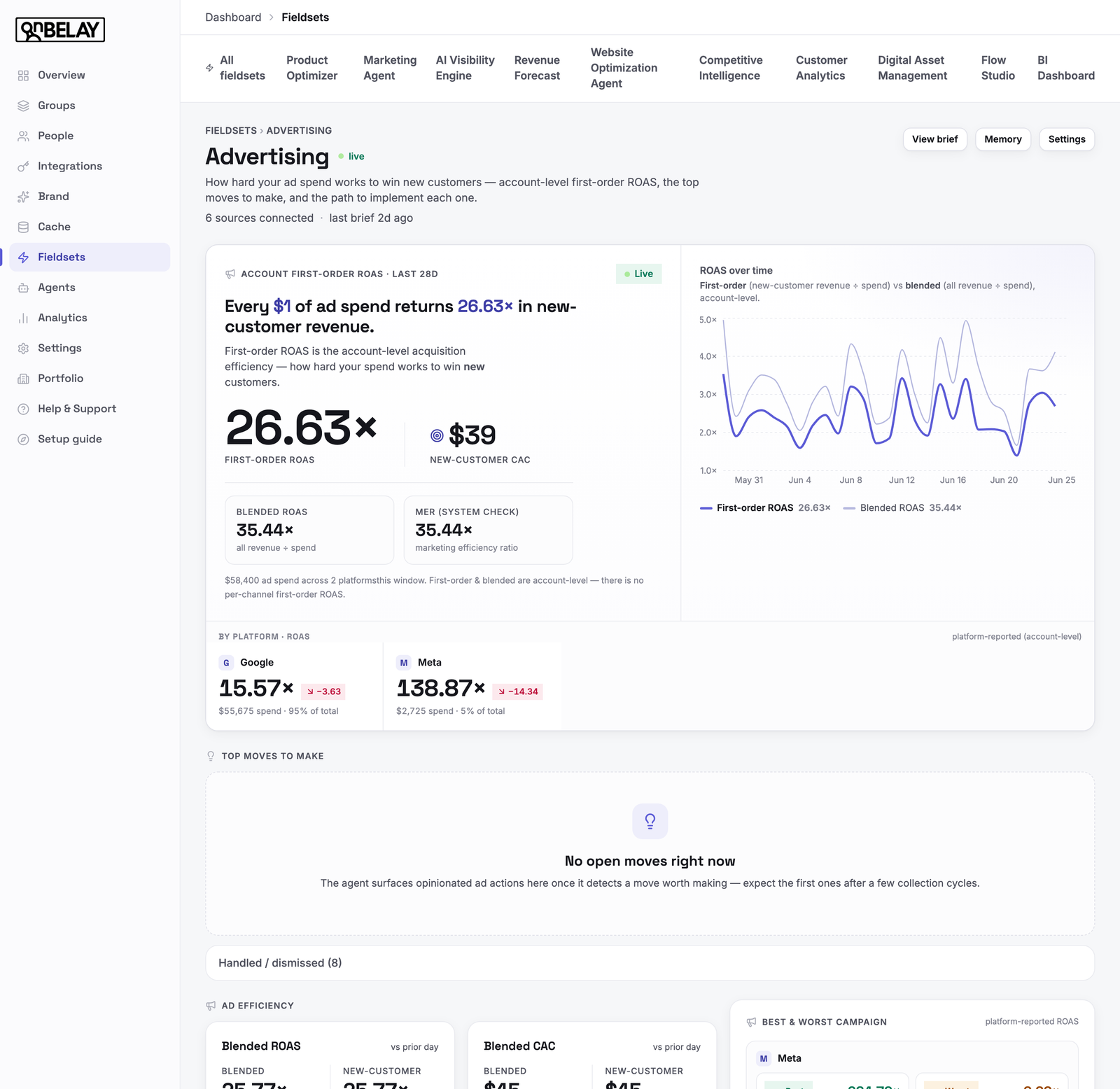
Context loaded: Advertising · Clive Coffee. Google Ads + Meta Ads spend, Shopify order revenue, GA4, and Klaviyo loaded — all read-only. First-order attribution is tied to actual Shopify new-customer orders.
You
What's our first-order ROAS this month and where should I shift budget?
Claude
Month-to-date: account-level first-order ROAS is 26.63× — spend is working hard to win new customers. New-customer CAC is $39, blended ROAS 4.1×. By platform: Google first-order ROAS 31.2× (CAC $32, trending up), Meta 19.8× (CAC $51, down 8% WoW). Top move: shift ~15% of Meta prospecting budget into Google non-brand — it's acquiring new customers at a lower CAC and the trend is holding. I've drafted the reallocation but I won't touch any budgets without your approval.
Your ad dashboards aren't telling you the truth.
ROAS looks fine — until you ask what it actually bought you.
Blended ROAS hides new-customer acquisition.
A healthy blended number can be propped up by repeat buyers and brand search. It tells you nothing about whether your spend is actually winning new customers — the only thing that grows the business.
Ad dashboards don't tie to real Shopify revenue.
Google and Meta report their own conversions, double-count each other, and miss what really happened at checkout. Without your actual Shopify orders in the loop, the numbers are platform marketing, not truth.
Nobody knows the true CAC by platform.
Ask what it costs to acquire one new customer on Google versus Meta and you get a shrug or a spreadsheet built by hand last quarter. By the time you have an answer, the budget's already spent.
CAPABILITIES
An advertising analyst that understands acquisition.
Spend in. New customers out. Grounded in your real Shopify revenue.
Account-level first-order ROAS
How hard every dollar works to win a brand-new customer — measured against actual first orders in Shopify, not platform-reported conversions. The number that tells you if growth is real.
New-customer CAC and blended ROAS over time
Track what it truly costs to acquire a customer and how blended return is trending week over week — so you see the shift before it shows up in the bank account.
Per-platform breakdown with trend deltas
Google and Meta side by side — first-order ROAS, CAC, and the direction each is heading. Spot the platform quietly getting more expensive before you've overspent on it.
The top moves to make — with a path to implement
Not just a dashboard. Claude surfaces the highest-leverage budget shifts and drafts the reallocation, ready for you to approve and push live.
Refreshed from Shopify and your ad platforms
Numbers stay current because they're pulled from the source — Shopify orders plus live Google and Meta spend — not a stale export someone built last month.
Prompts that actually work.
Because the context is already there.
"What's our account-level first-order ROAS this month, and how does it compare to last month? Break it down by platform."
"Show me new-customer CAC by platform with the week-over-week trend. Where is acquisition getting more expensive?"
"Given current first-order ROAS, draft a budget reallocation across Google and Meta to lower blended CAC. Queue it for approval."
"Which campaigns have the best first-order ROAS but the lowest spend? These are our scale opportunities."
Connected integrations
 Shopify read
Built to analyze spend, not move it.
Your ad accounts are not a place for AI to improvise.
Read-only on every ad account
Claude pulls spend, conversions, and trends — but cannot change a single campaign, budget, or audience on Google or Meta from any session. Read-only is the permission model, not a setting.
No budget or campaign changes without approval
When Claude recommends a reallocation, it drafts it and queues it. Nothing shifts until a human reviews the move and says yes.
No customer PII in output
Analysis works at the cohort and account level. Individual customer identities never appear in a report or a prompt response.